Provenance that travels
Bind source, time, identity, policy, and transformation history to every evidence object.
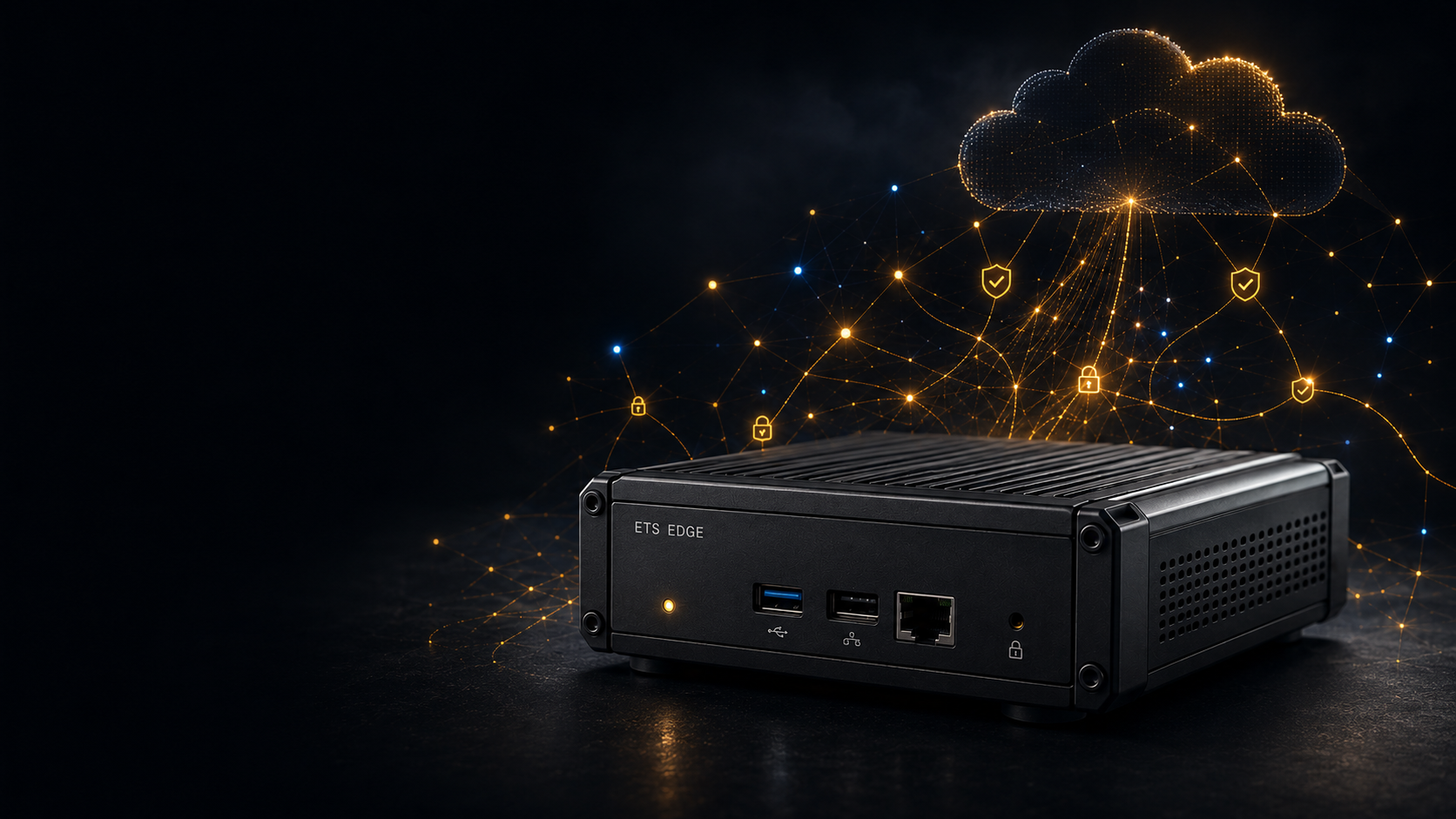
ETS creates verifiable evidence objects and decision lineage at the edge, synchronizing securely to cloud systems without losing provenance.
ETS Edge product concept · final specifications may change
THE MISSING LAYER
Logs, alerts, sensor readings, documents, and AI outputs move across platforms and trust boundaries. ETS preserves the evidence and the context needed to evaluate it—without replacing the systems you already operate.
Bind source, time, identity, policy, and transformation history to every evidence object.
Create signed checkpoints and portable proofs that can be verified outside a proprietary cloud.
Preserve the claims, conflicts, corrections, and assumptions behind consequential decisions.
HOW ETS WORKS
ETS makes the evidence lifecycle explicit. Each step preserves context that conventional logging pipelines often discard or hide.
Collect records at the source without forcing raw evidence into a new system.
Create deterministic evidence objects with consistent identity and context.
Cryptographically bind content, provenance, policy, and relationships.
Anchor signed checkpoints in append-only transparency records.
Package the exact material needed to support a claim or decision.
Allow independent verification across organizations and trust boundaries.
ARCHITECTURE COMPATIBILITY
ETS integrates through adapters, APIs, agents, and edge nodes. It is designed to work with heterogeneous estates—not demand a rip-and-replace program.
ONE EVIDENCE FABRIC
Deploy only the components the mission requires, then expand without changing the evidence model.
ETS EDGE
A physical or virtual node that validates, signs, stores, and forwards evidence—even during network interruption.
Appliance • virtual • embeddedETS CLOUD
Policy, registration, synchronization, retention, and evidence-graph services across distributed estates.
Managed • private cloud • hybridETS VERIFY
A verifier for signed checkpoints, evidence bundles, graph paths, corrections, and supersession history.
CLI • API • webETS DEVELOPER
SDKs and integration patterns for binding claims, AI outputs, events, and decisions to source material.
Open protocol • premium toolingETS AI
Preserve prompts, models, retrieval context, confidence, policy, and human decision lineage without reducing trust to one opaque score.
Edge inference • agent workflowsETS GOVERNMENT
Disconnected operations, cross-domain verification, retention controls, portable case files, and supply-chain provenance.
Pilot • enclave • enterpriseETS EDGE FAMILY
Reference profiles span compact development boards, production compute modules, NVIDIA-accelerated AI appliances, virtual nodes, and private-site deployments.
Compact, low-power evidence capture for labs, remote sites, cameras, sensors, and constrained environments.
Raspberry Pi 5 / Compute Module profileAccelerated local inference with source-bound claims, secure capture, and portable verification.
NVIDIA Jetson Orin profileVirtual or rack-scale nodes for regulated networks, critical infrastructure, and disconnected operations.
Customer-controlled deploymentHardware shown is a product concept and reference form factor; final production specifications may change.
HIGH-CONSEQUENCE EVIDENCE
COMMERCIAL MODEL
The protocol is intended for broad, portable adoption. ETS is the premium implementation for organizations that need managed scale, assurance, support, policy controls, and certified deployment profiles.
Open specifications, reference verification, developer access, and evidence that does not become useless when a vendor relationship ends.
Fleet management, enterprise policy, hardened appliances, assurance services, private deployment, integration, and accountable support.
RESEARCH + FUNDING READINESS
The ETS R&D agenda is structured for measurable Phase I-style investigation, dual-platform implementation, adversarial testing, and independent verification.
Deterministic identity and serialization across edge, cloud, and independently implemented verifiers.
Verifiability after redaction, selective disclosure, retention action, and federated trust-boundary traversal.
Synchronization that exposes gaps, conflict, replay, clock drift, reordering, and correction lineage.
AI-extracted claims that remain linked to exact source fragments, model context, confidence, and human decisions.
FOUR-WEEK CONTROLLED PILOT
Typical paid proof of concept: $10,000–$25,000, scoped to one meaningful evidence path and an agreed verification outcome.
Evidence path, custody rules, threat model, and success measures.
Edge or virtual node, adapters, policies, and verification profile.
Interruption, mutation, conflict, correction, and performance tests.
Portable proof bundle, findings, economics, and scale roadmap.
THE COMPANY
Lantern Protocol is the product and research initiative behind ETS, developed by EchoMedia.ai LLC in North Carolina. The company is focused on portable, verifiable digital evidence across heterogeneous computing environments.
PARTNER INQUIRIES
We are forming a focused group of design partners, pilot customers, researchers, hardware collaborators, government stakeholders, and aligned funders.
QUESTIONS
No. ETS is a verifiable evidence layer beneath and across existing systems. Raw evidence can remain in customer-approved storage while ETS preserves digests, provenance, relationships, checkpoints, and proof material.
ETS uses cryptographic commitments and append-only transparency patterns where they fit, but the architecture does not require cryptocurrency or a public blockchain. Deployment and verification profiles are policy-bound.
The edge profile is designed for capture and local verification during interruption, followed by explicit synchronization that exposes missing, conflicting, reordered, corrected, or superseded evidence.
Lantern Protocol identifies ETS as patent-pending technology. Detailed claim scope is reserved for appropriate diligence and partner conversations; the site does not imply that a patent has issued.
Lantern Protocol is recruiting design partners for controlled pilots, architecture assessments, and research collaborations while the product and protocol mature.